
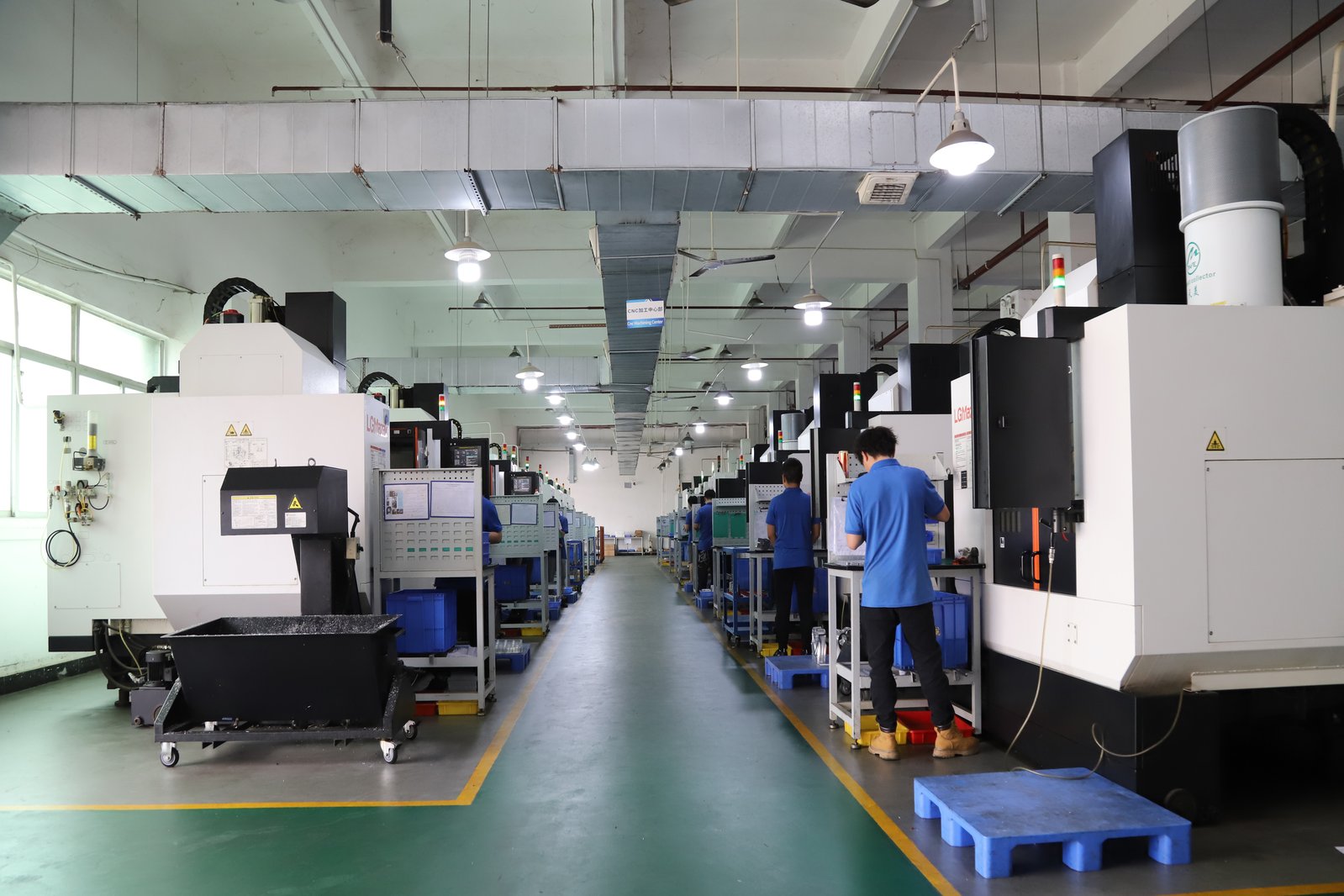
If you are buying custom parts from China and your first instinct is "machine it," you are in good company, and you may be overpaying. CNC machining is the most flexible process for producing a single part to tight tolerances from a wide range of materials, but it is subtractive: every part starts from a block of solid material, and the price includes buying material you then cut away. Casting, forging, molding, and additive processes start from a different economic base, and for the right part at the right quantity each one wins. This guide gives you a four-question filter — quantity, geometry, material, and tolerance — that points most parts to the right process before you ask for quotes, and it explains how to compare machining services against the alternatives without being misled by a cheap unit price.
What is CNC machining actually best at, and when is it the wrong default?
CNC machining wins on three things: flexibility, tolerance, and material integrity. There is no tooling to amortize, so one part and ten thousand parts start from the same program. Machining holds fit and alignment features to ±0.003 mm, and precision grinding extends that to ±0.002 mm, bands that casting and printing cannot approach on their own. And machined parts are cut from wrought bar or plate, which carries predictable, documented mechanical properties in a controlled temper — 6061-T651, 7075-T7351, 17-4PH in H1025 — rather than the properties of a cast or printed microstructure.
The same features make machining the wrong default in three situations. When the part is produced in volumes that repay a die or mold, a casting or molding process will usually undercut machining on unit price. When the geometry only exists because of a process — an internal lattice, an undercut that a mold releases, a near-net blade shape — forcing it through a mill is either impossible or wasteful. And when the material itself is a casting grade, machining from billet of a different alloy is not a like-for-like substitute. The discipline is to let the material and volume lead, then check the tolerance against what each process can deliver.
How does the required quantity move the process decision?
Quantity is the fastest filter because the processes differ most on their setup cost. Machining spreads programming and fixture cost across whatever you order, and the MOQ is effectively one piece. Casting, forging, and injection molding carry tooling that has to be amortized; additive processes carry no tooling but a high per-part cost that only falls when the design exploits the process. The table below is a rough map, not a rule — real breakpoints depend on part size and geometry.
| Quantity range | Processes worth quoting | Why |
|---|---|---|
| 1–10 parts | CNC machining, 3D printing | No tooling; programming or setup is the only fixed cost |
| 10–100 parts | CNC machining, printing with finish machining | Tooling still rarely pays back; machining usually wins on tolerance and finish |
| 100–1,000 parts | Machining, investment casting, casting-to-machine hybrids | Tooling starts to amortize; cast blanks with machined faces become competitive |
| 1,000+ parts | Die casting, forging, MIM, plastic injection molding | Tooling cost per part is small; cycle time and material efficiency dominate |
Two cautions keep the map honest. First, "quantity" means the quantity you will actually buy over the life of the design, not the quantity in the first order — a die that amortizes over 5,000 parts is not justified by an order of 500 followed by a design change. Second, reorderability matters: a machined part can be re-quoted from the same program at any time, while a cast or molded part commits you to maintaining tooling and its condition. If your design is still moving, machining is the cheaper place to be.
Which geometries push a part out of machining and into another process?
Machining is a subtractive process with reach limits. A tool must be able to enter the feature, so internal corners carry a radius, deep cavities need long tools, and enclosed channels are simply impossible to mill from outside. When the design genuinely needs an internal cooling passage, a hollow blade with a complex internal structure, or a deep pocket that a standard tool cannot reach at an acceptable stiffness, the honest processes are casting with a core, additive manufacturing, or molding, not a heroic machining setup.
Before you switch processes on geometry grounds, separate what the design needs from what a draft or model file happens to contain. Many parts with "impossible" internal geometry are drawings that would machine fine with a redesigned corner radius or a split line. A good machining supplier's DFM review will tell you which features are truly unreachable and which are one small change from machinable, and that review is the cheapest geometry consultation you will get. Only when the feature is genuinely process-dependent should the process decision follow the geometry rather than the other way around.
How does the material callout decide the process, and the price?
Material and process are two halves of one decision, because the useful engineering materials are not all available in every form. Wrought alloys — bar, plate, forgings — have the directional grain and controlled temper that machined structural parts rely on, which is why high-load parts specify 7075-T7351 or 17-4PH H1025 and machine from solid. Casting grades such as A356 aluminum or 17-4PH in the cast condition exist because the part needs a shape that only a mold produces, and their properties are specified for that condition, not for billet. Specify a wrought alloy and machine it; specify a casting alloy and cast it — mixing the two is a material error, not a process preference.
Material availability also drives price in a way buyers under-estimate. Machining a large part from billet means buying a block and cutting most of it into chips; when the design is a thin shell, a casting or forging that starts near the final shape can cut the material bill dramatically even before the unit-price math. Titanium and nickel alloys amplify the effect, because the raw material dominates the quote. When a part is big and thin, ask for both routes: the machined-from-solid price and the cast-then-machined price, with the material weights shown separately. The comparison will often surprise you.
Where does 3D printing genuinely beat machining, and where does it lose?
Additive manufacturing wins when the geometry is additive-native and the material is expensive enough that waste matters. Internal cooling channels in a mold insert, lattice structures for lightweighting, complex brackets in titanium that would need hours of machining and a block of titanium — these are parts where printing produces the shape and machining is reduced to finishing the mounting faces. At low volume, with no tooling and no material to cut away, the printed route can be genuinely cheaper than machining from solid.
Additive loses on the qualities machining buyers depend on. Printed surfaces carry layer steps, so a smooth or sealing face needs secondary machining or polishing to reach even a modest Ra; printed tolerances sit in a range that most mechanical drawings cannot accept without post-processing; and the microstructure, residual stress, and material certification of a printed part are different questions from those of wrought material. The practical pattern is hybrid: print or cast the near-net shape, then machine the datum faces, bores, and sealing surfaces to the tolerance and finish the drawing demands. That pattern is also where a machining services supplier adds value — it can quote the finishing half of the job and tell you honestly whether the near-net route is worth it.
When do casting, forging, and MIM beat machining on cost per part?
Casting, forging, and metal injection molding all amortize tooling across volume and produce parts closer to the final shape than a billet ever is. Die casting produces aluminum and zinc parts in high volumes at cycle times measured in seconds; investment casting handles complex shapes in steel, stainless, and superalloys; MIM fills the small, intricate, high-volume niche that machining does poorly. Forging earns its place where the application needs the grain flow and strength of a forged microstructure rather than machined-from-bar properties.
The breakpoint is not a fixed number — it is wherever the tooling cost divided by quantity drops below the machining premium. A large sand casting with simple tooling can pay back at a few hundred parts; a complex die-cast tool can need tens of thousands. Two realities keep the comparison honest. First, cast, forged, and molded parts almost always need some machining — draft, parting lines, as-cast tolerances, and surface finish guarantee it — so compare the fully finished cost, not the raw blank price. Second, count the quality risk of a new tool in your decision: the first article from a new die is an adventure, while a machined part from a proven program is not. For a part whose design is still maturing, the stability of machining is part of its value.
How do tolerance and surface finish requirements filter the options?
Tolerance is the most decisive filter because it is the least negotiable. Casting and additive processes typically work in tenths of a millimetre on their best day; machining holds fit and alignment features to ±0.003 mm, and precision grinding reaches ±0.002 mm, with capability of Cpk 1.67 or higher on key characteristics and Cpk ≥ 1.33 on general characteristics. Capability is reported per characteristic: every report names the feature, its tolerance band, the sample size, the sigma method, and the study window. When a drawing carries the tight bands on a bore, a sealing face, or a locating surface, the process question is settled: those features are machined, and the only open question is whether the rest of the part is also machined or arrives as a near-net blank with machined features.
Surface finish filters the same way. A machined finish in the Ra 3.2 µm range is routine, and grinding and polishing take Ra lower on the faces that need it; cast surfaces carry the texture of the mold, and printed surfaces carry layer steps. If the drawing's critical surfaces are functional — sealing, bearing, wetted — the finish requirement will pull the part toward machining regardless of volume. When you shortlist processes, put the tolerance and finish callouts from your drawing next to each process's realistic capability before you request quotes. It will save you the cost of quoting a cast part that cannot hold the drawing and the delay of discovering it at first article.
How should you compare total cost across processes when sourcing from China?
Compare total cost at your real quantity, with every element on its own line. The quote structure should separate tooling (one-time), unit price, secondary operations such as finish machining or surface treatment, inspection, and freight — a supplier that buries tooling in the unit price is not giving you a comparable number. At your annual quantity, add the tooling divided by the total parts you will actually buy, and add your own inspection and qualification cost for a new process, because a first die or mold has a qualification cycle that a proven machining program does not.
Then compare processes, not just suppliers. Quote the same drawing to a machining services shop, a casting house, and an additive specialist, and ask each what it would change in the design to make its process cheaper — the DFM answers are where the real comparison lives. A machining supplier that tells you honestly when casting would be cheaper is rare and worth keeping; the machined parts guide explains how material, tolerance, and finish land on a quoted machined part, and the FAQs cover how DFM feedback and quoting work. The goal is not to defend machining — it is to pick the process that delivers your part at the lowest total cost, and to let each process compete on evidence rather than habit.
One cost that never appears on a quote is the cost of switching back. Move a part to casting or molding and a later design revision means paying for a tool modification or a new tool, with the lead time starting over; a machined part absorbs a revision as a program change plus a first-article run. That asymmetry argues for staying with machining while the design is young, and for locking the design before you commit tooling anywhere. When you compare processes, add a line for revision risk: under each option, what does a change to the drawing cost you in money and weeks? For most buyers the answer, early in a program, keeps the part on the machine, and that is a legitimate part of the total-cost comparison, not a bias toward machining.
Frequently Asked Questions
When should I machine a part instead of casting it?
Machine when volume is too low for tooling to pay back, when the drawing carries tolerances only machining can hold, or when you need wrought-material properties in a specific temper. Casting wins on high volumes of a settled design that can tolerate cast tolerances and draft.
Is 3D printing cheaper than CNC machining for low volumes?
Sometimes — for parts whose design exploits additive freedom, printing can win on piece price at low volume. The comparison flips when the drawing demands machined tolerances or finishes, because the part then needs secondary machining. Price both routes with the finish requirement included.
Can I print or cast a near-net part and machine the critical faces afterward?
Yes — it is the standard route for high-value parts. The near-net process makes the general shape, and machining cleans up datums, bores, and sealing surfaces to drawing tolerance. It only works when the design leaves enough stock and the datum strategy is planned across both processes.
Which aluminum should I specify if a part might be machined from billet?
6061-T651 for general parts — stress-relieved, stable, easy to cut — and 7075-T7351 for higher loads or thinner sections. If the design instead starts as a casting, the alloy changes to a casting grade, which is why material and process have to be decided together.
What tolerance can each process realistically deliver?
Casting and additive processes typically work in tenths of a millimetre. Machining holds fit and alignment features to ±0.003 mm, precision grinding reaches ±0.002 mm, and Cpk of 1.67 or higher is demonstrated on key characteristics. Where the drawing carries the tight bands, machining is effectively mandatory.
Should the prototype and the production part use the same process?
Yes, when the process choice is application-driven, because machined-from-bar and cast or printed material behave differently under load and finish. For a pure fit check a different process is fine; for a performance validation, keep the process and material condition identical to production.
How do I get a like-for-like quote across different processes from China?
Send the same drawing and annual volume to each process specialist and demand the same quote structure: tooling on its own line, unit price, secondary operations, and inspection. Compare total cost at your real quantity. A quote that hides tooling in the unit price is not comparable to one that shows it.
Not sure whether your part should be machined, cast, printed, or molded?
Email [email protected] or call +86 13126536955 — you will get an honest read on the process, including when machining is not the right answer.