
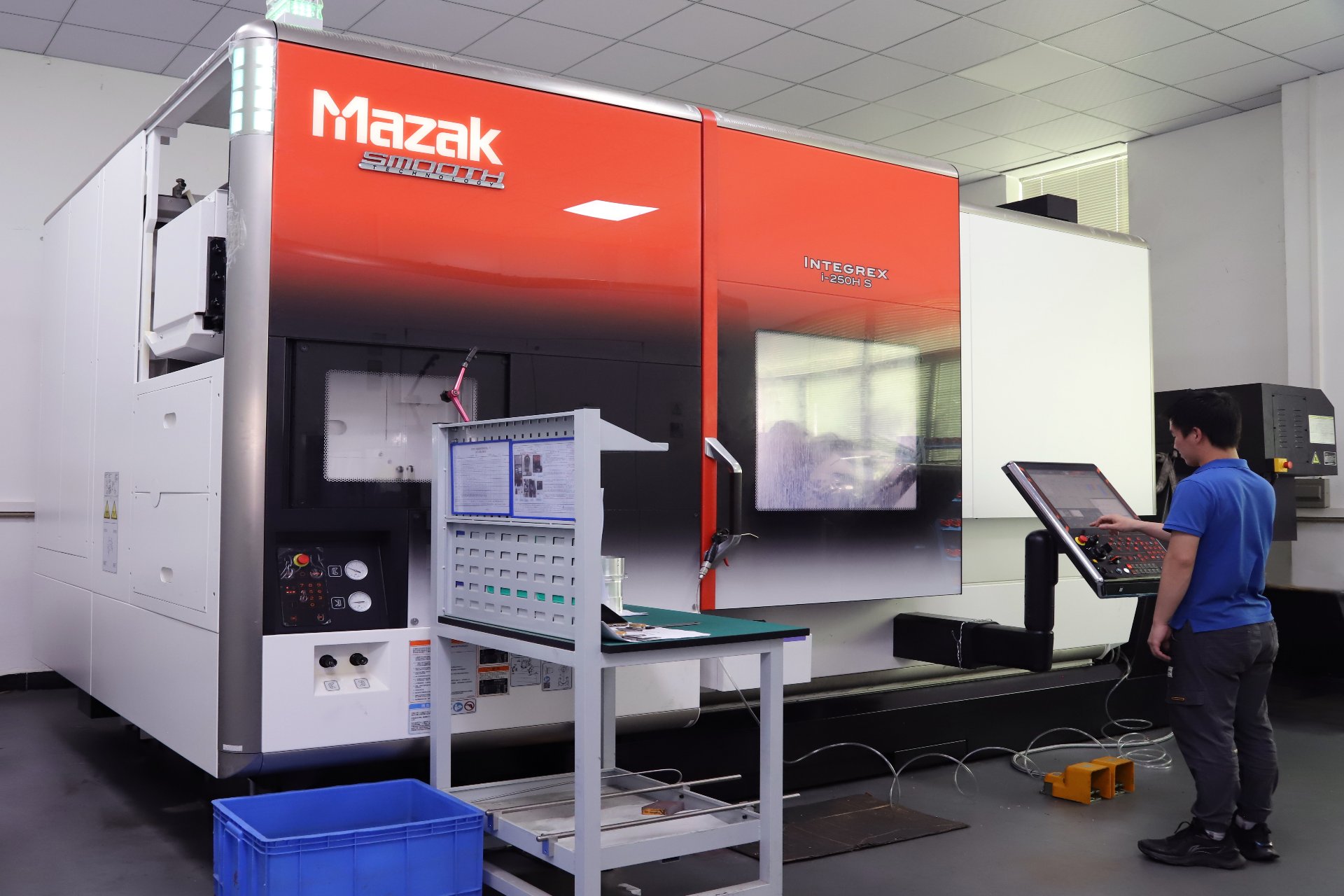
Every machining quote from China is built from the same stack of decisions, and the price only means something when you know what is inside each layer. Material, geometry, tolerance, quantity, finishing, inspection, freight — each one moves the number, and suppliers who quote different stacks will honestly return different prices for the same drawing. This article breaks the stack down layer by layer, so a buyer in 2026 can read a quote, compare it fairly, and see where the money actually goes.
1. What actually drives the price of China machining services?
Start with the biggest lever, which is not labour: it is material and geometry. The hourly cost of a machine in South China is a small fraction of the difference between cutting 6061 aluminum and cutting Ti-6Al-4V, or between a simple block and a thin-walled housing with deep pockets and tight corners. Material sets the floor of the quote, and geometry decides how many hours sit on top of that floor. A buyer who understands these two factors can predict most of the price variation before ever seeing a quote.
The second tier is process cost: the number of setups, the toolpath time, the fixturing, and the risk of scrap. A part that can be finished in one setup on a 3-axis machine prices differently from one that needs indexing or a 5-axis cycle. A part with thin walls needs conservative feeds to avoid vibration, which adds time. These are engineering costs, and a good shop reflects them honestly rather than compressing them into a round number that falls apart at the first nonconformance.
Machine class is part of the geometry story. A 3-axis milling hour prices differently from a 5-axis hour, and turning differently from grinding, so the quote should name the machine class behind each operation line. When it does not, you cannot tell whether the price reflects the most efficient machine for the part or the one the shop wants to keep busy. Ask which machines will run each operation, and read the answer.
2. How do material choice and stock cost move the quote?
Material cost enters the quote twice: as the price of the stock, and as the price of cutting it. On the stock side, buy-to-fly matters — a housing machined from a large billet pays for the whole billet, including the metal that becomes chips. On the cutting side, the alloys differ enormously: 6061-T6 cuts fast and predictably, 7075-T6 is harder on tooling, 304 and 316L work-harden, 17-4PH is often machined annealed and then heat treated, and titanium and Inconel cut slowly with real tooling wear. Each step up the list multiplies both the stock price and the machine time.
The buyer's lever is specification discipline. Name the grade and condition on the drawing and do not pay for an exotic alloy where a standard one works. A 7075 part that can run in 6061, or a 316L part that can run in 303, carries a real premium for no functional return. And confirm the shop can source the named grade with a certificate before comparing quotes, because a supplier quoting an unverifiable substitute has changed the material, not just the price.
3. How much does tolerance add to a machined part?
Tolerance moves price because it moves the process. Features inside the ±0.003 mm milling and turning envelope run on controlled toolpaths with in-process checks and normal inspection. Features that need ±0.002 mm add a grinding step with its own setup, wheel selection, and CMM verification. Every characteristic you tighten adds setup and inspection time, and — more quietly — it adds risk, because a tight feature that drifts scrapes the part or the whole batch.
The discipline is to tolerance only what function requires. A mating bore and a seal face earn their tight callouts; a cosmetic pocket does not. Use GD&T to express the critical features against defined datums, and leave the rest to a stated general tolerance. This is where a buyer with a disciplined drawing saves real money, because the shop prices the process your callouts demand, not the process it hopes you meant.
A tolerance that matches the shop's natural process is nearly free; one that forces a different operation is not. When a characteristic sits comfortably inside the ±0.003 mm envelope, run at Ppk ≥ 1.67 initial on critical features, it adds little cost. The moment a callout pushes the part into a grinding step or a slower toolpath, you are buying a different process. Asking which features trigger a process change is the fastest way to see where the tolerance premium is really going.
4. How much does quantity change the per-part price?
Machining has no tooling to amortize, so the quantity curve is flatter than for molding or casting. What falls with volume is the share of fixed cost: programming, fixturing, first article inspection, and the operator's setup time spread over more parts, plus the ability to buy material in longer bars at a better rate. The drop from one piece to ten is steep; from ten to a hundred it continues; beyond a few hundred it tapers, because the machining time itself is a constant that volume cannot remove.
That shape matters for strategy. If your annual need is two thousand parts but the design is still moving, machining is often cheaper than tooling a die or mold that revision two will obsolete. If the design is frozen and the volume is tens of thousands, the flat machining curve is the signal to start modelling a tooled process. The crossover is a spreadsheet question, not a guess, and it should be recalculated whenever the quantity forecast changes.
Prototype quantities deserve their own note. A single part carries the full fixed cost — programming, fixture, first article — so its price tells you nothing about the per-part price at volume. When a prototype exists to validate a design that will later run in hundreds or thousands, ask the shop for the prototype price and the projected volume price on the same drawing, so the sample does not distort your cost model.
5. How much of the quote is finishing, plating, and anodizing?
Finishing is where quotes quietly diverge. Anodizing, hard-coat, plating, powder coating, and heat treatment are separate process steps with their own handling, their own yield, and their own lead time, and on a small part they can rival the machining cost. Two quotes for the same machined part can differ by a third simply because one includes type II anodize and the other quotes bare machined surfaces — both honest, both describing different products.
Treat finishing the same way you treat tolerance: specify it where function needs it, and leave it off where it does not. When it is required, ask for the specification — anodize class, plating thickness, hardness target — and ask the shop to itemize the finishing line so you can see its cost. A supplier that bundles a vague "surface treatment" into the price is hiding a cost that should be visible, and a hidden cost is a negotiating problem waiting to happen.
Finishing also carries a yield risk that machining does not. An anodize or plating run has its own rejection rate, and a racking mistake can damage parts that were perfect out of the machine. When the part is tight and the finish is critical, ask whether the shop checks dimensions before and after finishing, and how a rejected finish lot is handled — the answer belongs in the quotation, because it decides who absorbs the re-run cost.
6. What should a China machining quote include to be comparable?
Comparability starts with six fields. The material grade, including the certificate. The tolerance assumption, including the default for un-dimensioned features. The finish specification, or an explicit statement that surfaces are as-machined. The inspection deliverables — material certificate, dimensional report, CMM data where critical. The incoterm and freight method, so the price means the same thing in two currencies. And the lead time, because a quote without a date is a number, not a quotation.
Ask every supplier the same question about each field, in writing, and read the answers for specificity. A supplier that states "general tolerance ±0.1 mm unless otherwise noted, critical features at ±0.003 mm with CMM evidence, certificate and report included, DAP to your door" has given you a comparable quotation. A supplier that answers "best price, quality guaranteed" has given you a reason to keep shopping. The parts page of this site shows the scope of work these quotations cover.
7. Where do freight, duties, and currency sit in the total landed cost?
Freight is not an afterthought; it is a line that can move the delivered price more than the machining difference between two suppliers. Air freight from South China runs in days and costs per kilogram, which suits small, light, high-value parts. Sea freight costs less per kilo but adds weeks and container minimums. Insurance and import duty sit on the declared value. The comparison that matters is total landed cost — ex-works, freight, insurance, duty — over your real quantity.
Two practical rules. First, ask each supplier to state the incoterm rather than assume it; a low FOB price with expensive freight is not a low delivered price, and neither is a quote that quietly excludes the export packaging. Second, compare in one currency and ask about payment terms — the deposit and the balance milestones — because the cost of money is part of the cost of the part. The quality page of this site describes the documentation that should ride with the shipment and justify the freight spend.
Packaging and marks are a small line that trips up first-time buyers. Ask whether the quoted price includes export packaging, part marking, and the shipping documents, and what happens to parts that arrive damaged in transit. None of these lines is expensive, but each is invisible until it is missing, and a quote that excludes them is cheaper for a reason.
8. Which cost traps turn a cheap quote into an expensive part?
The cheapest quote is rarely the cheapest part, and the traps are predictable. A quote with no material certificate is pricing a material that may not arrive; a quote with no tolerance assumption is pricing an interpretation of your drawing; a quote with no inspection line is pricing a part that will be measured by nobody. Each omission is not a saving — it is a risk transferred to you, to be paid later in inspection time, rework, and disputes.
Weight the remaining risk signals honestly. A supplier that answers with process detail has priced the real part; a supplier that answers with enthusiasm has priced hope.
One final trap is the sample-price bait: a dramatically low first-article price that assumes the critical features are looser than your drawing states. Before you celebrate the number, ask which tolerance each critical feature was quoted to and whether the price includes the CMM report that proves it. On machined parts, the difference between a real quote and a bait quote is almost always visible in the tolerance assumption, not in the arithmetic.
A shop certified to ISO 9001:2015, IATF 16949:2016 (product design excluded) and ISO 14001:2015, with documented inspection on the factory page of this site, is the kind of operation whose quote you can compare feature by feature. In 2026 the buyer's edge in China machining is not finding the lowest number — it is knowing what each number contains.The buyer's rule of thumb: price the specification, not the quote. Same drawing, same material, same tolerance, same inspection, same incoterm — then the difference between two suppliers is real, and the cheapest number means something.
Frequently Asked Questions
What is the biggest driver of cost in China machining services?
Material and geometry usually dominate, before labour is even considered. A titanium part costs many times a 6061 part of the same shape, and a part with tight tolerances, thin walls, or deep pockets takes longer and risks more scrap. Quantity then spreads the setup and programming over more parts, which is why per-part price falls as volume rises.
How much does tolerance add to a machined part?
Tolerance moves the price because it moves the process. Features inside the ±0.003 mm milling and turning envelope run on controlled toolpaths with in-process checks; features that need ±0.002 mm add a grinding step, a different fixture, and CMM verification. Each tightened characteristic adds setup and inspection time that quantity cannot fully absorb.
Why are quotes from different Chinese shops so different?
Because the specification inside them differs. One quote may assume general tolerances of ±0.1 mm with no reports, while another prices your critical features at ±0.003 mm with CMM evidence, a material certificate, and finishing included. Level the comparison by sending the same drawing, the same material, the same inspection deliverables, and the same incoterm to every shop.
What does quantity do to the per-part price?
Machining has no tooling to amortize, so the fall is shallower than for molding or casting. The setup, programming, and first-article cost spread over the run, and the shop can buy material in larger bars. The savings are real from one piece to a few hundred, then taper — beyond that, the per-part curve flattens and volume is rarely the cheapest lever left.
How much of a machining quote is finishing and plating?
A real share. Anodizing, plating, powder coating, and heat treatment are separate process steps with their own handling and yield, and on a per-part basis they can rival the machining cost for small parts. Specify finish only where function needs it, and ask each shop to itemize finishing so you can see what you are paying for.
What should a China machining quote include to be comparable?
Six things: the material grade and certificate, the tolerance assumption, the finish specification, the inspection deliverables, the incoterm and freight method, and the lead time. If any of the six is missing, the quote is incomplete, and comparing incomplete quotes is how buyers pick the wrong supplier.
Where do freight and duties sit in the total landed cost?
On top of the ex-works price. Air freight from South China runs in days and adds a predictable cost per kilogram; sea freight is cheaper per kilo but adds weeks and minimums. Duties apply on the declared value. Always compare total landed cost — ex-works, freight, insurance, and duty — not the first line of the quotation.
Need a machining quote you can actually compare?
Send the drawing, the material, and the quantity through the contact page — the quotation returns with material, tolerance, inspection, incoterm, and lead time stated line by line.